Talking quantum error correction at Q-FARM
Prof. Harry Zhou’s seminar connected high-rate quantum codes to hardware constraints, and I had the chance to share an early draft of my own work with him.
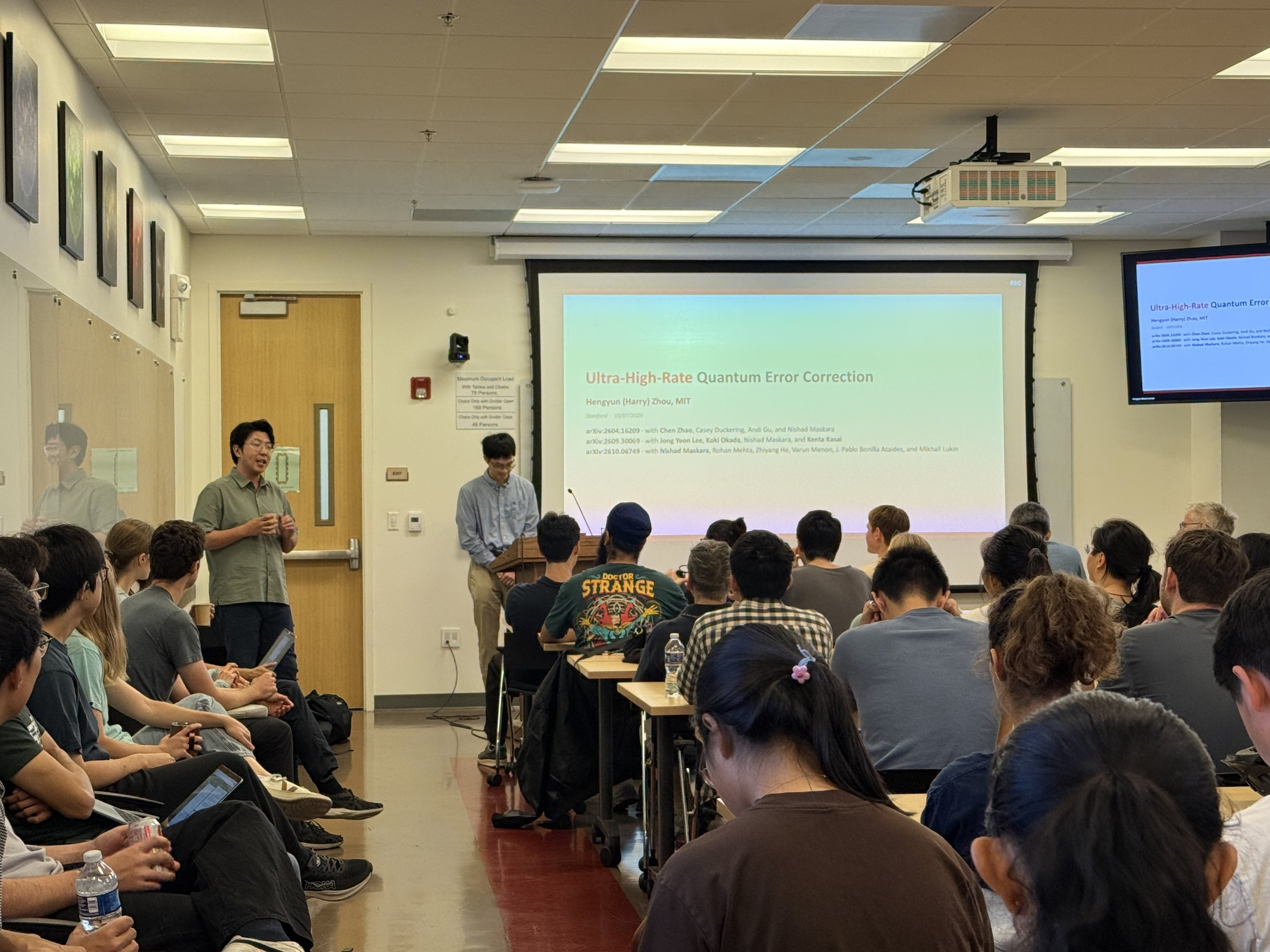
On October 7, I went to Stanford Q-FARM to hear Prof. Hengyun (Harry) Zhou of MIT speak about “Towards ultra-high-rate quantum error correction.” His talk connected the design of high-rate codes with the hardware needed to make them useful.
What stayed with me was the set of trade-offs: encoding rate, distance, check weight, and blocklength cannot all be optimized independently. The seminar also linked code constructions to syndrome extraction and the practical constraints of reconfigurable neutral-atom arrays. It gave me a more concrete way to think about how an elegant code becomes an implementable system.
The best part of the visit was speaking with Prof. Zhou afterward. I told him about my work on certifying delivered entanglement and gave him an early draft of the paper.1 My project asks a different question from his talk, but both have made me think harder about what a quantum system can promise when noise and implementation details matter. I hope we can continue the conversation and find an opportunity to collaborate.
Thank you to Q-FARM for hosting the seminar and making room for conversations after the talk. That exchange was the part I took home with me.
- “Early draft” is a generous description: it was half built. I hope it read like an early-access release, not a bug report. ↩