What can a quantum network promise about the entangled pairs it delivers?
Per-pair guarantees need a model; hidden random tests can certify the average quality of kept pairs without one.
Manuscript in preparation (October 2026). This independent study at Carnegie Mellon's Information Networking Institute is with Prof. Michael Mattarock. The manuscript asks what a network can promise about the entangled pairs it gives its users. The code, pre-registrations, results, and audit trail are public; the third-party experimental data are not redistributed.
The question
Entangled pairs will be used for teleportation, secure keys, and distributed computation. But measuring a pair to check its fidelity consumes it. If a user needs a pair above a given quality threshold, what evidence can the network provide without destroying that pair?
What the two layers promise
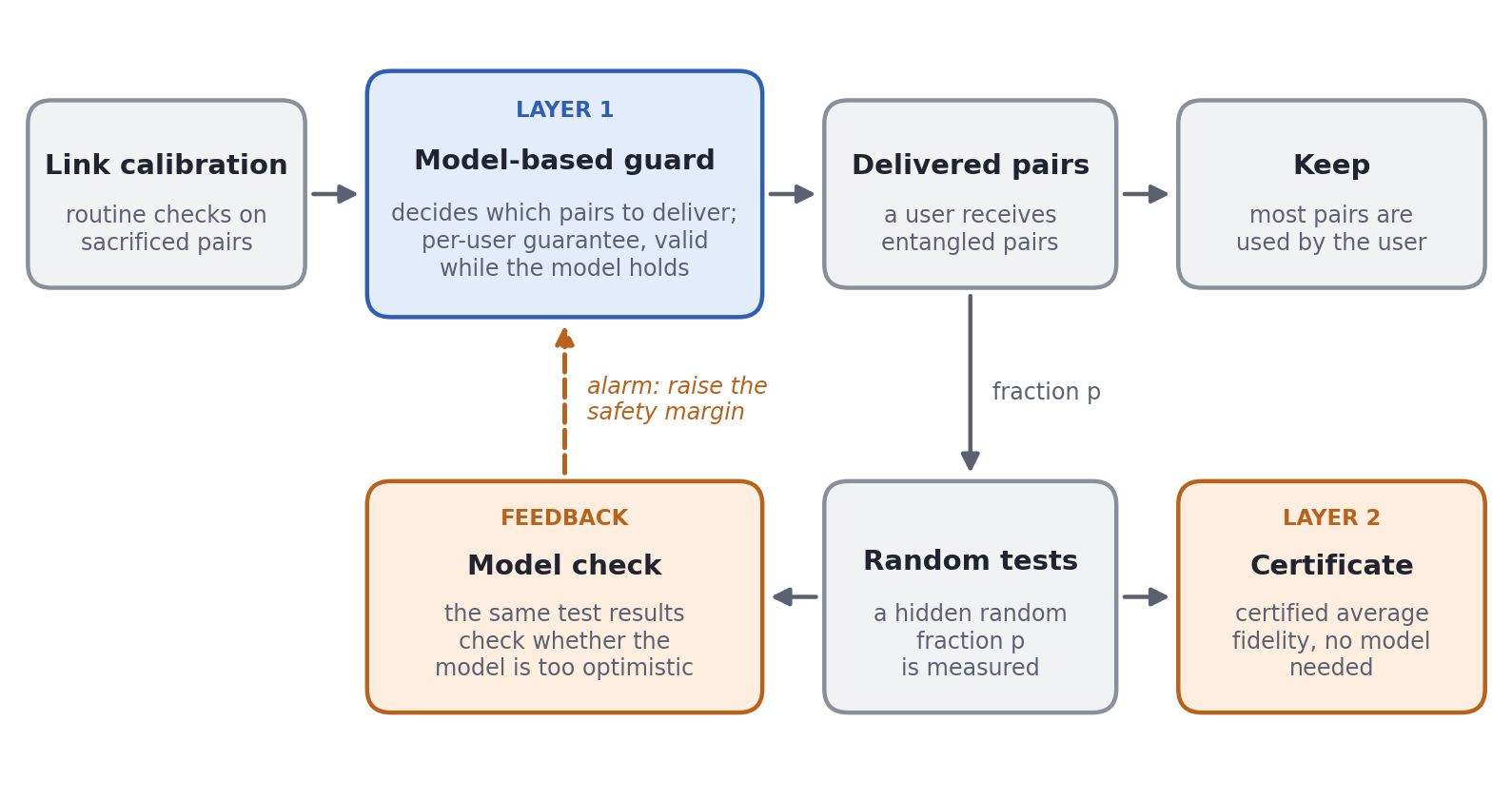
Tests on a small random fraction cannot reliably clear every pair when most pairs are kept. Rare bad pairs can escape the sample even when the measured average looks good. The manuscript therefore separates a per-pair claim from an average certificate:
- The model-based guard uses calibration counts, conservative confidence bounds, and a physics model to decide which pairs to deliver. It can limit the chance that a user ever receives a below-threshold pair under adaptive routing, provided the model and its declared margins cover the actual noise.
- The model-free certificate uses a hidden random subset of pairs for tests. With trustworthy measurements, it gives an anytime lower bound on the average fidelity of the pairs users keep. It says nothing definitive about any one kept pair.
- The model check uses those same tests to look for an optimistic guard. Within a declared class of model errors, a running bound can set a safer margin after an alarm, or from the start. An alarm cannot undo deliveries made before it.
The distinction has a cost. If 10% of perfect pairs are reserved for random Pauli tests, this anytime certificate needs 678 kept pairs to certify average fidelity above 0.9; the manuscript proves a lower bound of 330 for that test setting.
Evidence and limits
Network simulations. On square grids up to 30 × 30 nodes, none of 4.2 million pairs delivered after an alarm fell below threshold; with the margin active from the start, none of 7.8 million did. Three further pre-registered studies tested 3D cubes, a grid with diagonal links, and square grids up to 37 × 37. Across 36 topology-and-method cells of 32 simulated networks each, no network had a harmed user, and none of about 8.8 million guarded deliveries was bad. The delivery count is descriptive: outcomes within one simulated network are not independent observations. Detection was slower on one 5 × 5 × 5 cube condition, so the work does not claim topology-independent alarm speed. These are simplified simulations, not physical network trials.
Five experimental-data re-analyses. Data from ICFO and USTC show calibration noise beyond a simple binomial model. A USTC memory-model point estimate was optimistic by 2–4 fidelity points, although that offset was not statistically significant. Innsbruck data gave a 95% lower fidelity bound of 0.887. On a Delft diamond-spin link, raw measurement counts alone did not certify entanglement; the authors' readout correction did.
Oxford's 2022 device-independent QKD experiment. The authors provided time-ordered records for a characterisation run of 1,920,000 heralded pairs, with a random test-or-keep decision after each herald. In the pre-registered re-analysis, the 95% anytime lower bound on the average fidelity of 944,576 kept pairs ended at 0.917 and remained above 0.9 after 219,185 kept pairs, assuming the nominal measurement settings were trustworthy. The separate device-independent bound was 0.837. This re-uses the Oxford team's data; it is not a new hardware run by me.
Local quantum hardware. Two test-or-keep runs on one IBM processor checked components of the protocol. The certificate stayed below a noisy Bell-measurement reference in both runs. An initial model check missed an injected degradation; a revised check alarmed in the second run. The reference is not ground truth, and the pairs were never distributed over a network.
From routing to guarantees
I began with reinforcement-learning policies for routing in noisy quantum grids. Better routing did not tell a user whether the pair they received was good. That moved the project toward conditional per-user guarantees, a separate certificate for kept-pair averages, and a feedback rule for model optimism.
The manuscript documents the pre-registration record, exceptions, corrections, and failed predictions. Across the main and topology studies, 83 of 95 primary hypotheses passed and 12 failed. The most important practical limit is still detection: small model errors may take too long to reveal themselves, and a sufficient safety margin must be in place before an error can cause harm. The manuscript remains in preparation.
Code, results, and citation
The main repository contains the analyses and audit trail; the topology repository holds the 2D and 3D extensions. The v0.9.1 archive matches the manuscript. Experimental datasets remain with their original publishers or authors.
Rajpal, T. S., & Mattarock, M. (2026). What can a quantum network promise about the entangled pairs it delivers? (code and data) (Version 0.9.1) [Software]. Zenodo. doi:10.5281/zenodo.23468145.