Phase Hunter and a week at Q-SITE Hacks 2026
Three podium finishes, a close IonQ fourth place, and Phase Hunter: a playable experiment about quantum phases and noise.
Three certificates from Q-SITE Hacks 2026, a near miss, and a game about noisy quantum measurements.
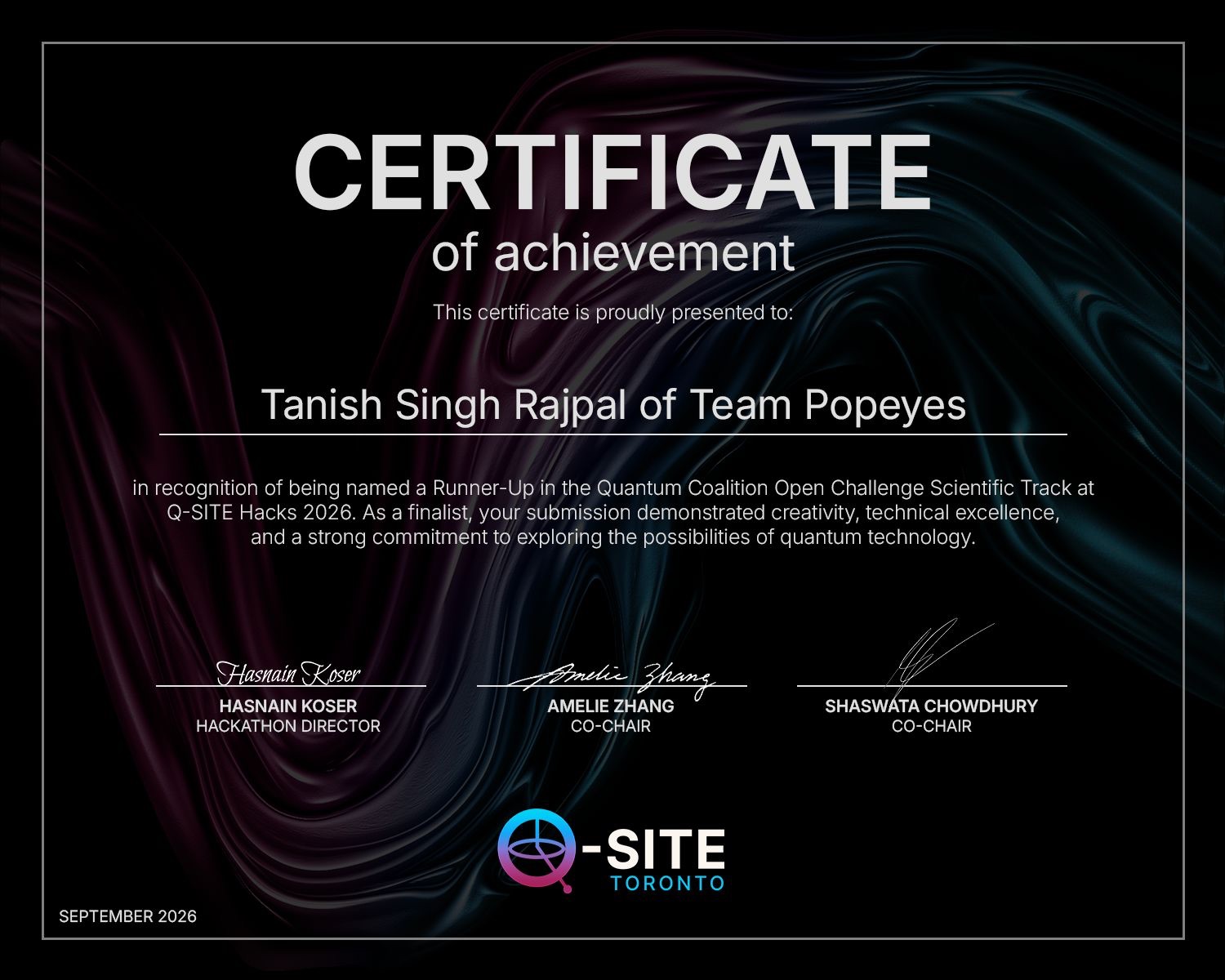
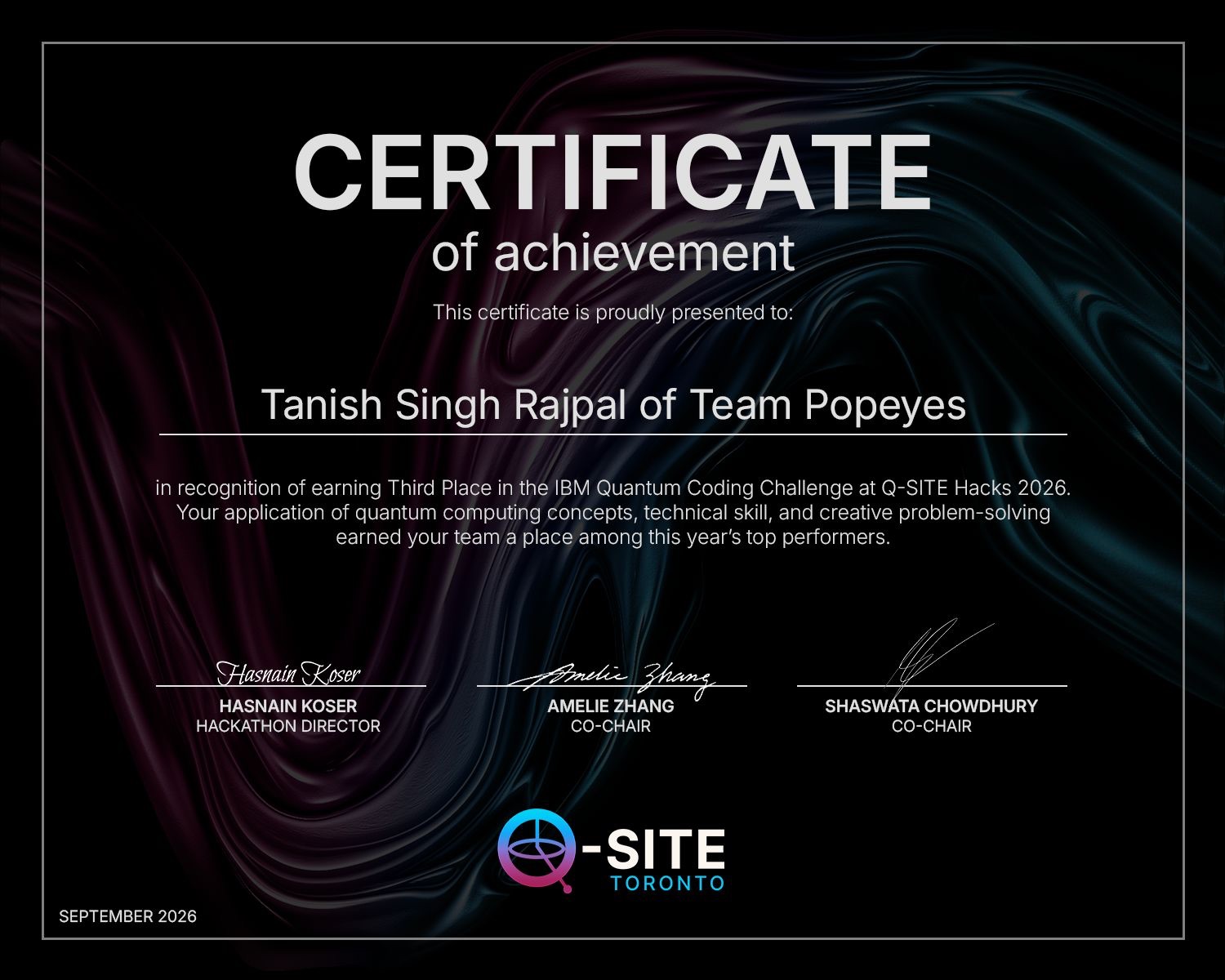
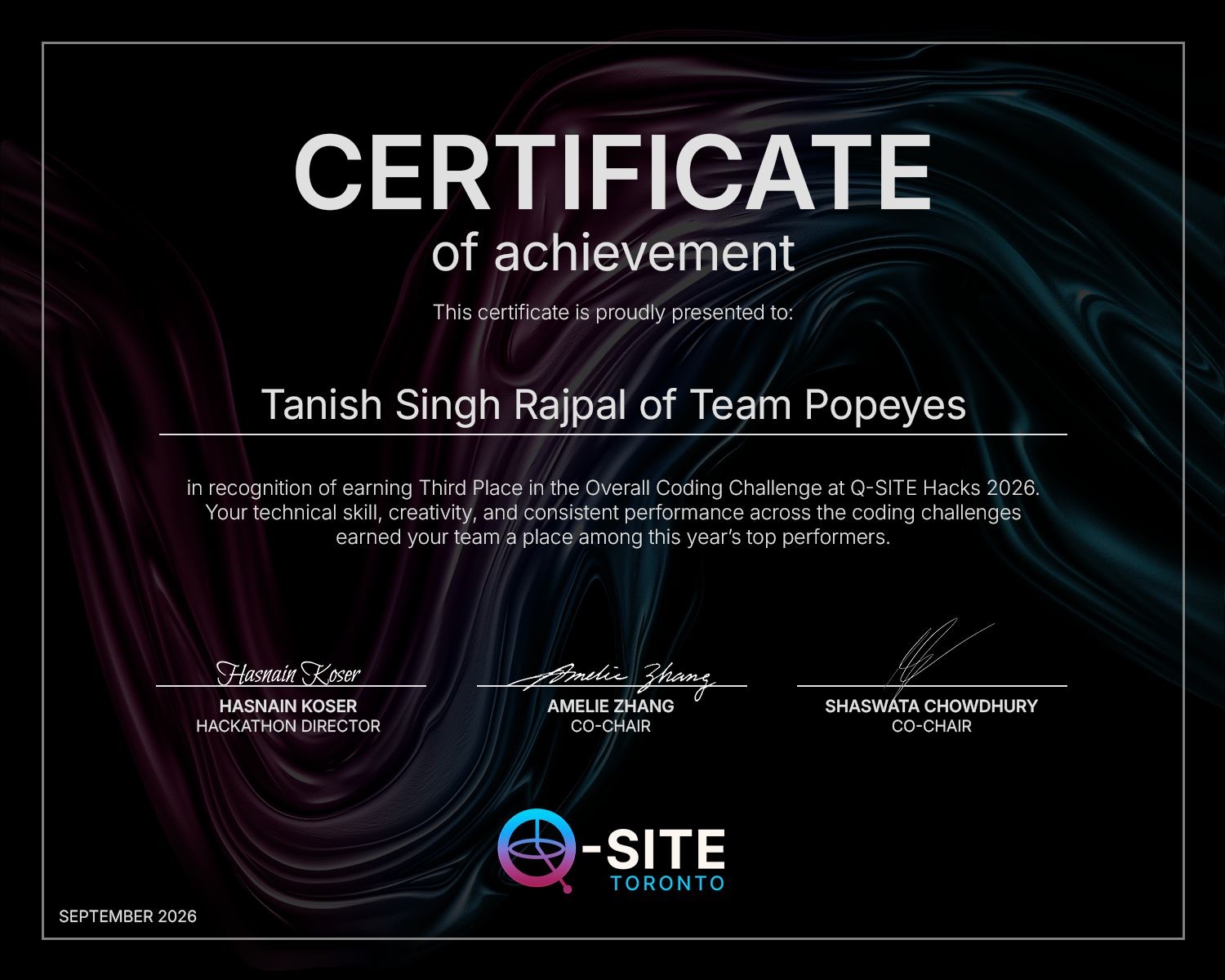
At the University of Toronto’s Q-SITE Hacks, part of Qiskit Fall Fest 2026, our team placed third in the IBM Quantum Coding Challenge and third in the Overall Coding Challenge. We were runner-up in the Quantum Coalition Open Challenge’s Scientific Track. In the IonQ Championship, we finished fourth, 0.44 points off the podium.
Certificates and results
The three certificates recognize the Scientific Track runner-up finish and both third-place coding results. In the IonQ Championship, Team Popeyes scored 100.00 on attack and 12.58 on defense, for an official total of 56.29—fourth place, 0.44 behind third. View the leaderboard snapshot ↗
Phase Hunter
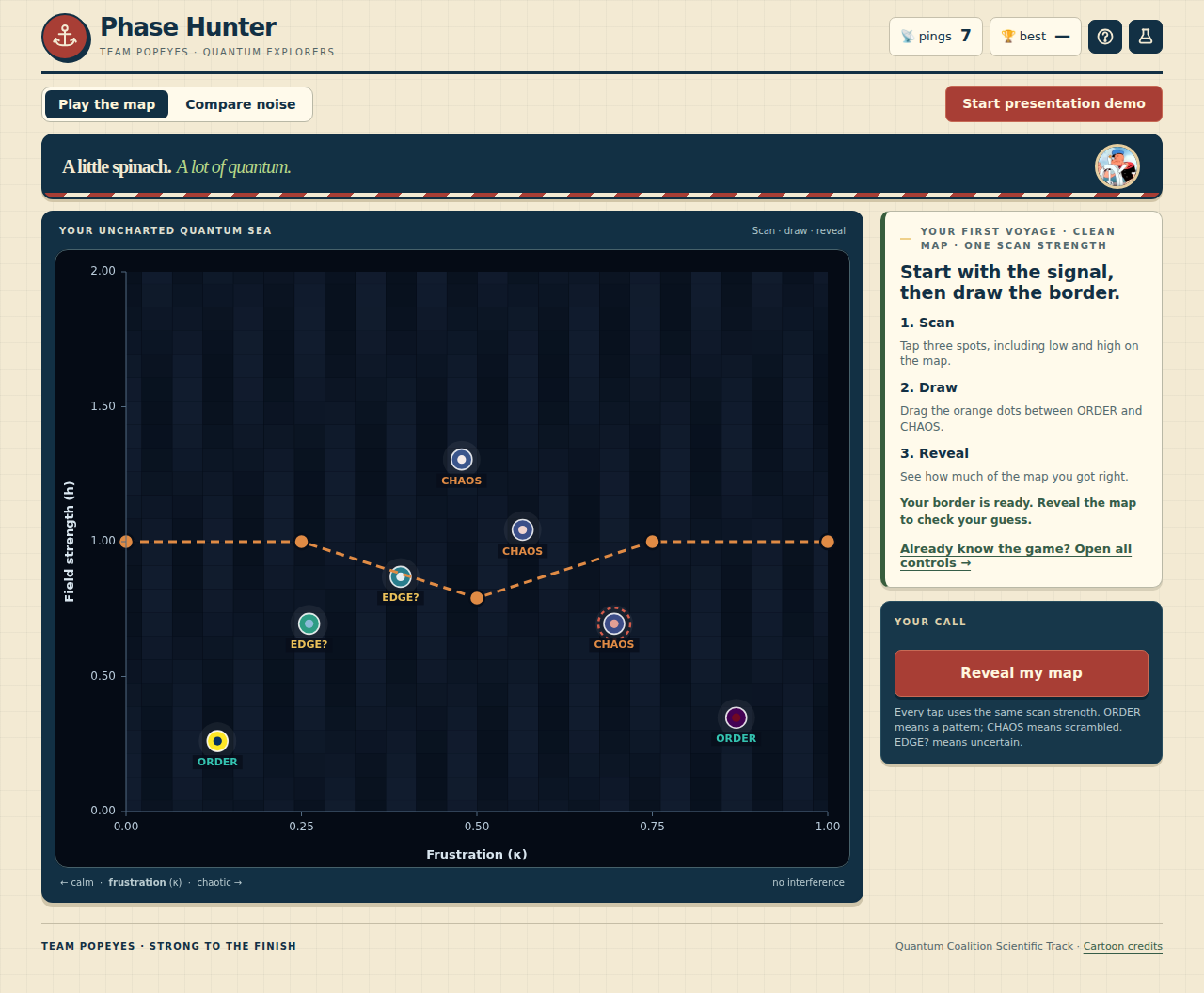
For the Scientific Track, Paul Jeon, Sumedhaa Ruhil, and I built Phase Hunter. It turns a question about quantum spin phases into a playable experiment: with only a handful of measurements, can you find the hidden phase boundary in a ring of quantum spins?
The game is the front end of a reproducible PennyLane simulation. Its notebook compares clean, noisy, and error-mitigated phase maps. Two findings stayed with us. Noise reduced the correlation signal and the area of the correctly mapped phase in different ways: the stripe phase lost more signal, while the aligned phase lost more map area. Under the smallest shot budget we tested, a simpler lower-noise baseline outperformed the correction method we tried. These are results from our simulation, not claims about a physical device.
Watch the Phase Hunter demo ↗ · Explore the code and notebook ↗
Team Popeyes, continued
The team name has a history. Hiram Zúñiga came up with “Team Popeyes” when we were teammates at Yale’s YQuantum hackathon. I carried it into Q-SITE with Paul and Sumedhaa. Consider this an acknowledgment to Hiram and a continuation of the legacy: a little spinach, a lot of quantum.
Thank you to Paul and Sumedhaa for building this with me, and to the Q-SITE organizers, judges, and the University of Toronto for hosting. I’m also grateful to IBM Quantum and Qiskit, IonQ, Xanadu and PennyLane, the Quantum Coalition, PINQ², and AWS for making the challenges and workshops possible.